
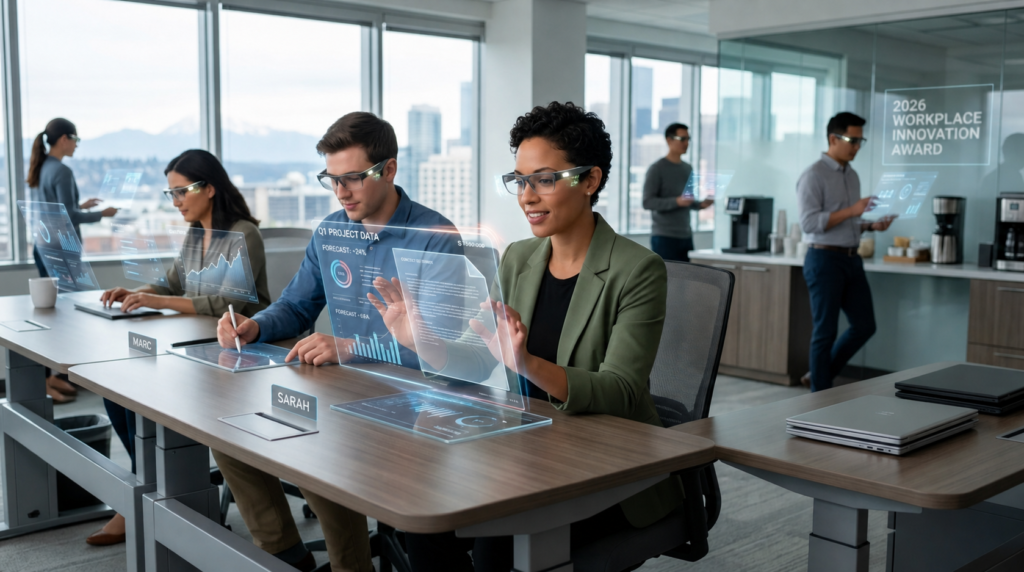
I recently tested AI glasses during a remote work project, and honestly, the experience changed how I think about productivity. Instead of carrying my laptop everywhere, I simply wore lightweight smart glasses that projected my entire workspace in front of me. As a result, I handled emails, joined meetings, and edited documents without opening a single device. This shift made me realize that AI glasses in the US workplace 2026 are not just a trend, they are becoming a real replacement for laptops.
Moreover, companies across the United States are rapidly adopting AI-powered wearables to improve efficiency and flexibility. While laptops once dominated office culture, AI glasses now offer hands-free computing, real-time assistance, and seamless collaboration. Therefore, the conversation around “the death of the laptop” is no longer hypothetical. Instead, it reflects a growing transformation driven by artificial intelligence, augmented reality, and modern workplace demands.
Why Are AI Glasses Replacing Laptops Faster Than Expected?
AI glasses in the US workplace 2026 are evolving rapidly, and businesses are embracing them for multiple reasons:
- Employees access virtual screens anywhere without physical hardware
- Workers complete tasks faster using voice commands and AI assistance
- Companies reduce hardware costs and maintenance issues
- Remote teams collaborate in immersive digital environments
- Professionals multitask efficiently without switching devices
How AI Glasses Improve Workplace Productivity Dramatically?
AI-powered smart glasses are redefining productivity in ways laptops cannot match:
- Real-time AI suggestions help write emails, reports, and code faster
- Hands-free operation allows multitasking during meetings or fieldwork
- Instant data visualization appears directly in the user’s view
- Workers reduce distractions by avoiding multiple tabs and apps
- Voice-to-action commands eliminate repetitive manual tasks
Why Do US Companies Prefer AI Wearables Over Traditional Devices?
Organizations across the US workplace are shifting toward AI glasses because they deliver strategic advantages:
- Businesses enable hybrid work without bulky equipment
- IT departments manage fewer physical devices
- Companies improve employee mobility and flexibility
- Training becomes faster using augmented reality overlays
- Decision-making improves with real-time AI insights.
Key Features That Make AI Glasses Better Than Laptops
AI glasses outperform laptops due to their advanced features and seamless integration:
- Augmented reality displays replace physical screens
- Built-in AI assistants provide contextual support
- Lightweight design improves comfort and portability
- Cloud-based systems remove storage limitations
- Eye-tracking and gesture controls enhance user interaction
Challenges Slowing Down the Death of the Laptop
Despite rapid adoption, laptops are not completely obsolete yet:
- High cost limits accessibility for small businesses
- Privacy concerns arise with always-on cameras and sensors
- Battery life still needs improvement for all-day use
- Some complex tasks require traditional computing power
- Users need time to adapt to new interfaces
Real-World Use Cases of AI Glasses in the US Workplace 2026
AI glasses are already transforming different industries:
- Corporate professionals attend virtual meetings with holographic displays
- Healthcare workers access patient data hands-free during procedures
- Engineers visualize 3D models directly on-site
- Retail staff assist customers with real-time product information
- Remote workers create fully portable digital offices.
The Role of Artificial Intelligence in Smart Glasses Adoption
Artificial intelligence is the core driver behind this shift:
- AI automates repetitive office tasks
- Machine learning personalizes workflows for each user
- Natural language processing enables voice interaction
- Predictive analytics improves decision-making speed
- AI assistants act like digital coworkers
Future of Work: Will Laptops Completely Disappear?
The future workplace will likely combine both technologies, but AI glasses will dominate:
- Laptops may become secondary devices for heavy tasks
- AI wearables will handle daily workflows
- Offices will shift toward screenless environments
- Digital workspaces will become more immersive
- Employees will rely more on voice and gesture controls
Conclusion
AI glasses in the US workplace 2026 are reshaping how professionals work, collaborate, and interact with technology. While laptops still serve specific purposes, their dominance is clearly fading. As AI-powered wearables continue to improve, they offer unmatched flexibility, efficiency, and mobility. Therefore, businesses are rapidly adopting this innovation to stay competitive. The “death of the laptop” may not happen overnight, but without doubt, AI glasses are leading the next evolution of the modern workplace.
FAQs
1. Are AI glasses replacing laptops completely in 2026?
Not entirely, but they are reducing the need for laptops in daily tasks.
2. What are the main benefits of AI glasses in the workplace?
They offer hands-free computing, improved productivity, and real-time AI assistance.
3. Are AI glasses expensive for businesses?
Yes, initial costs are high, but companies save money long-term on hardware and maintenance.
4. Can AI glasses handle complex tasks like coding or design?
They can assist, but advanced tasks may still require traditional computers.
5. Are AI glasses safe in terms of privacy?
Privacy concerns exist, especially with cameras and data tracking, but regulations are evolving.
Pingback: Local AI: 5 Best AI PCs and Laptops for Privacy in 2026 - AIVerse Hub