
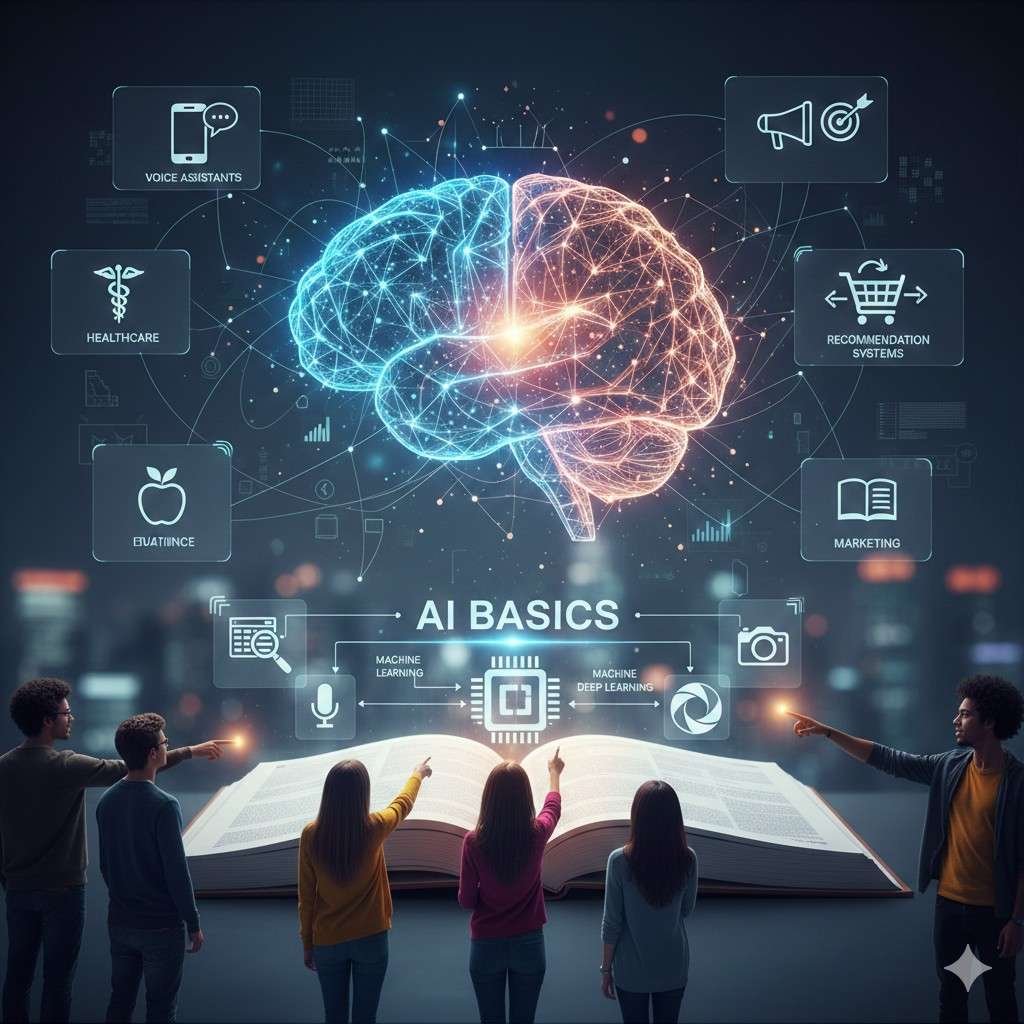
Artificial Intelligence is changing the way we live and work every day. In this Artificial Intelligence tutorial for beginners, I will explain the artificial intelligence basics in simple words. I believe understanding the AI definition is the first step toward learning this powerful technology. AI is about building intelligent machines that can think and learn like humans. The demand for AI skills is growing fast in every industry. That is why learning AI is becoming important for beginners like us.
An AI tutorial for beginners 2026 starts with understanding what artificial intelligence actually is. For example, AI enables machines to simulate human intelligence such as learning, reasoning, and problem-solving. In addition, AI includes technologies like machine learning and deep learning
Popular AI Tools for Beginners
AI tools make it easier to learn and apply concepts.
Examples:
- ChatGPT
- Google Colab
- TensorFlow
- Scikit-learn
As a result, beginners can experiment with real projects without complex setups.
Understanding Concept of Artificial Intelligence
I will explain artificial intelligence as the ability of machines to think and act smartly. For example, When I say smart, I mean machines that can learn from data. The AI definition focuses on creating systems that copy human intelligence. I see AI used to solve problems without human help. It helps computers make decisions using logic and patterns. I understand AI as a technology that improves with experience. The goal of AI technology is to make machines more useful for humans. I notice that intelligent machines can perform tasks faster than people. This basic meaning helps beginners clearly understand what AI really is.
Key concepts include:
- Machine Learning
- Neural Networks
- Natural Language Processing (NLP)
- Computer Vision
Moreover, these concepts form the foundation for most AI applications.
Evolution of Artificial Intelligence
The evolution of artificial intelligence started as a simple idea and slowly became real technology. Scientists and researchers only discussed artificial intelligence in the early days. The goal was to create intelligent machines that could think like humans. In 1950, experts officially introduced the term artificial intelligence. Early AI systems followed fixed rules and logic. These systems had limited abilities and low computing power. Progress was slow due to a lack of data and technology. Many people doubted the future of AI at that time. Still, the AI developed. This stage marked the beginning of AI from theory to practice.
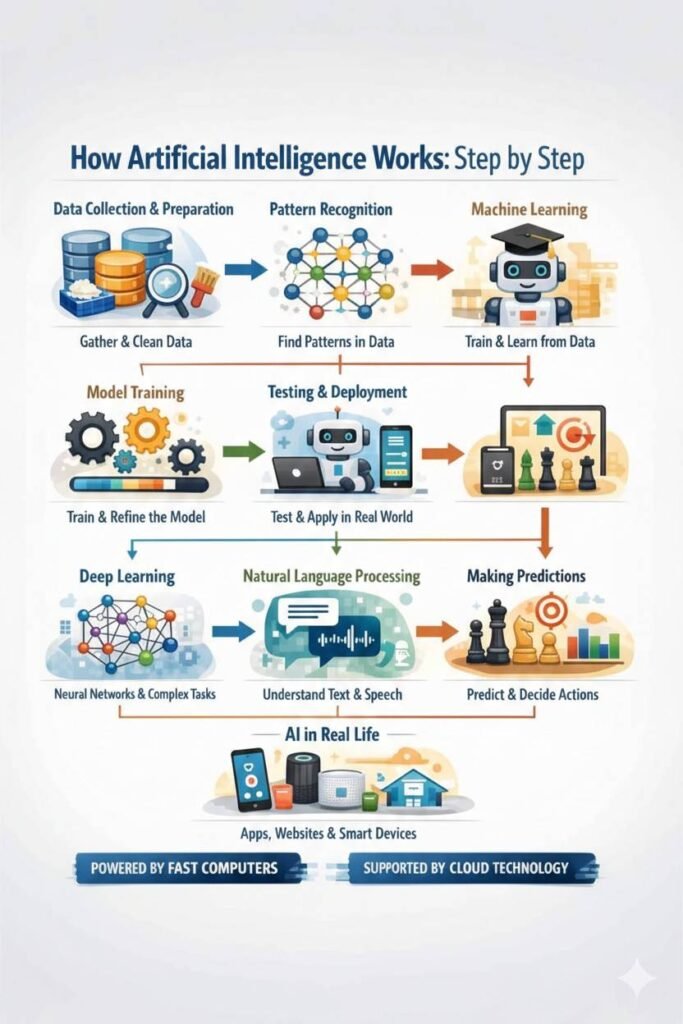
How Artificial Intelligence Works Step by Step?
Artificial intelligence works by using data, rules, and smart algorithms to perform tasks. Artificial intelligence systems start by collecting large amounts of data.We clean and prepare the data for learning. Then, AI algorithms analyze the data to find patterns. These patterns help machines make decisions. Machine learning enables AI to learn from past data without direct programming. In addition, we train the system repeatedly to improve accuracy. As a result, continuous learning reduces errors and enhances overall performance. This process helps AI give better results over time. That is the basic way how AI works in real situations.
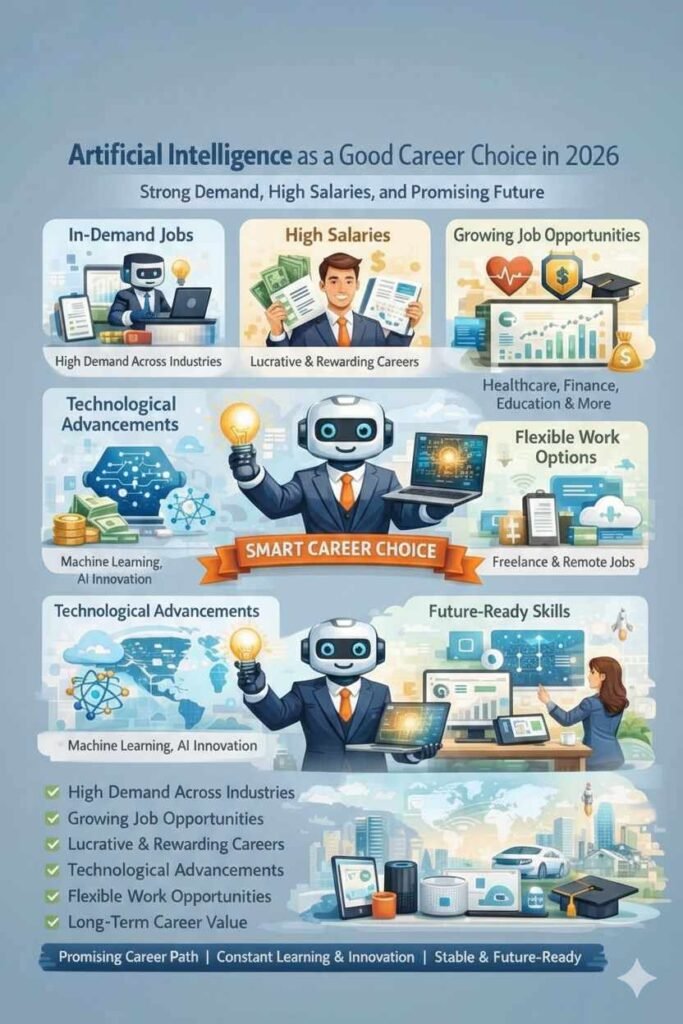
Artificial Intelligence as a Good Career Choice in 2026
Today’s digital world considers artificial intelligence a great career choice. The demand for artificial intelligence jobs is increasing across industries. Companies need skilled professionals to handle AI technology and automation. AI helps businesses improve speed, accuracy, and decision-making. This creates strong demand for trained experts. The scope of AI careers is expanding across healthcare, finance, and education. High salaries make AI an attractive option for learners. AI skills are useful in both technical and non-technical roles. Global companies invest heavily in AI innovation. This shows AI has long-term career value. The future of artificial intelligence looks stable and promising.
Key Skills Required for Learning AI in 2026
To succeed in an AI tutorial for beginners 2026, certain foundational skills are required. First, basic programming knowledge is recommended, especially in Python, as it is widely used in AI development. In addition, a clear understanding of mathematics, including statistics and linear algebra, is important because these concepts are applied in machine learning models. Logical thinking and problem-solving skills are also developed through consistent practice. Moreover, many beginner-friendly resources are designed to simplify complex topics, so learners are guided step by step. By building these skills early, a strong base is created for advanced AI learning.
Real-World Applications of AI
AI is used across multiple industries.
For instance:
- Healthcare (diagnosis, monitoring)
- Finance (fraud detection)
- Marketing (personalization)
- E-commerce (recommendations)
In addition, AI continues to expand into new domains every year.
Common Challenges Beginners Face in AI Learning
While learning AI, beginners often face several challenges. For example, complex mathematical concepts are sometimes difficult to understand at first. In addition, choosing the right tools and frameworks can be confusing due to the large number of options available. Data handling and model training are also considered challenging in the beginning. However, these difficulties are gradually reduced through practice and guided tutorials. Moreover, many online platforms now provide structured courses that simplify the learning process. As a result, learners are able to overcome obstacles and improve their understanding over time.
Future Scope of AI in 2026 and Beyond
The future of AI is expected to expand rapidly in 2026 and beyond. For instance, AI technologies are increasingly being integrated into industries such as healthcare, finance, education, and transportation. Moreover, automation and intelligent systems are being adopted to improve efficiency and reduce human effort. New innovations are continuously being developed, which means more opportunities are created for learners and professionals. As a result, AI skills are becoming highly valuable in the job market. Therefore, beginners who start learning AI today are better prepared for future technological advancements.
Conclusion
An AI tutorial for beginners 2026 provides the perfect starting point for anyone interested in artificial intelligence. From understanding basic concepts to exploring tools and real-world applications, beginners can gradually build expertise. Moreover, AI continues to evolve, creating new opportunities across industries. In conclusion, learning AI in 2026 is not only valuable but also essential for staying relevant in the future of technology, innovation, and digital transformation.
FAQs
Q:1 What is Artificial Intelligence (AI)?
Artificial Intelligence is a technology that allows machines to think, learn, and make decisions like humans using data and algorithms.
Q:2 How does artificial intelligence work?
AI works by collecting data, using algorithms, and learning patterns through machine learning and deep learning models.
Q:3 What are the main types of artificial intelligence?
The main types of AI include narrow AI, general AI, and super AI, each with different intelligence levels and capabilities.
Q:4 What is the difference between AI, machine learning, and deep learning?
AI is the broad concept, machine learning is a part of AI that learns from data, and deep learning uses neural networks for complex tasks.
Q:5 What are common applications of artificial intelligence?
AI is used in healthcare, finance, education, marketing, transportation, and customer support systems.
Q:6 Is artificial intelligence a good career choice?
Yes, AI offers high demand, strong career growth, and good salary opportunities across many industries.
Q:7 Do beginners need coding skills to learn AI?
Basic programming skills, especially Python, are helpful, but beginners can start with simple AI concepts first.